From each structure of the eye, orbital tumors or growths can originate. The orbit is a space located behind the eye, containing the eye itself, the muscles that allow it to move, the optic nerve that transmits vision, and the lacrimal gland, which lubricates the front of the eye. All of these are surrounded by abundant fat that protects these delicate structures from the surrounding bones. Essentially, it’s the control center that enables the eye to function properly.
Orbital tumors can affect both children and adults. Additionally, tumors originating from nearby paranasal sinuses and the cranial cavity may infiltrate the orbit. Lastly, metastases from primary tumors in other organs (such as breast and prostate) can localize in the orbit. Orbital tumors affect children and adults equally, but fortunately, benign tumors are the most common in both cases.
Symptoms of Orbital Tumors
The most typical symptoms of an orbital tumor are eye protrusion (proptosis) and double vision (diplopia), although vision loss is also a frequent symptom. Patients noticing these changes should promptly consult an ophthalmologist, particularly one specialized in orbital surgery. Besides an ophthalmic examination, adequate radiological imaging (CT or MRI) is necessary.
Orbital Tumors in Children
The most common orbital tumors in children include dermoid cysts, often appearing as protrusions near the eyebrow’s tail, and capillary hemangiomas, which vary in appearance depending on their location.
Malignant orbital tumors in children are extremely rare, but a rapid progression of symptoms should raise suspicion for rhabdomyosarcoma. Orbital abscesses, caused by chronic sinusitis or idiopathic inflammatory processes (inflammatory pseudotumor), are relatively common in children and fall under the expertise of an ophthalmologist.
Orbital Tumors in Adults
A distinction must be made between benign and malignant tumors. Among benign tumors, the most frequent is the cavernous hemangioma, a malformative vascular “cyst.” While not immediately dangerous, its growth in the orbit can compress the “control center” structures, causing proptosis (eye protrusion), diplopia (double vision), and optic nerve compression (vision loss).
In such cases, surgical removal is necessary. An ophthalmologist specializing in orbital surgery can manage these malformations with minimally invasive techniques and eyelid approaches. Neurosurgical intervention is almost never required, avoiding more dangerous approaches (e.g., through the cranial cavity) and significantly reducing recovery time, often allowing for same-day discharge.
The most frequent malignant tumor is the orbital lymphoma, which requires a biopsy for diagnosis. It is typically treated with chemotherapy combined with radiotherapy. Less common but more aggressive are tumors of the lacrimal gland, which often require complex management, including radical surgery and chemoradiotherapy.
Case Study: Anna’s Journey
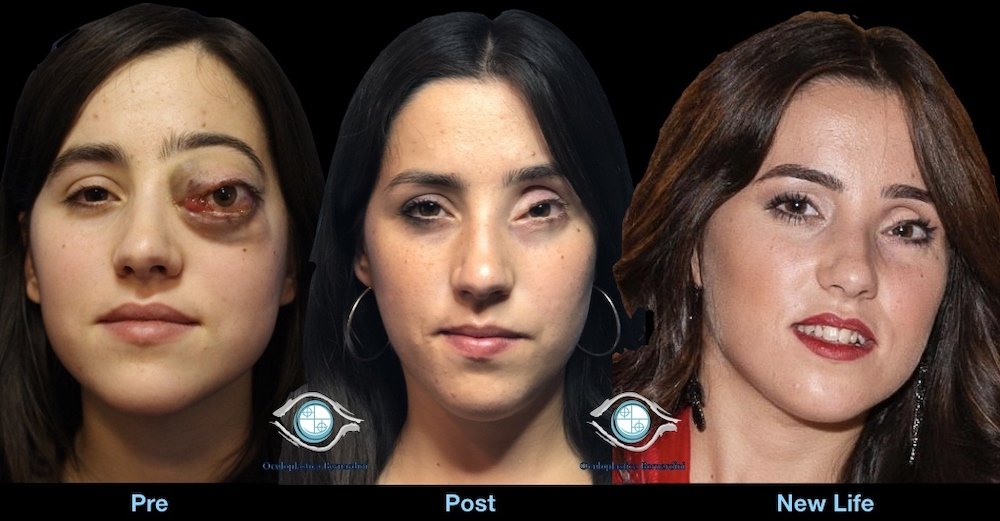
Anna came to me convinced her only solution was to have her eye removed. She was in such intense pain that she was ready to take this step, as she had been told nothing else could be done. She had already consulted specialists both in Italy and abroad.
Anna wore an eye patch because her condition was quite noticeable. She suffered from proptosis with pain caused by a retro-orbital growth, located behind the eye between the brain and the eye. It was one of the most difficult and inaccessible areas for a surgeon to reach.
This surgery was one of the most challenging of my career. Removing a widespread lesion within the orbit, enveloping the eye, optic nerve, and muscles, carried a very low chance of success without damaging surrounding structures.
Today, Anna is a beautiful woman with a lovely daughter, and most importantly, a perfectly normal eye. We took this risk together, holding hands. The surgery was a resounding success.
This remarkable young woman had lived for 20 years with a large vascular tumor behind her eye, unable to find anyone who could manage it, despite seeking solutions worldwide. I’m honored to have helped her find a new life filled with beautiful normalcy.


