


Excess skin in the lower eyelids affects 90% of my patients. It cannot be ignored, and the skin laxity and wrinkles must not be left untreated, as it creates an aesthetic flaw. Therefore, in ninety percent of cases, I remove the skin.
There are various ways to remove skin from the lower eyelids. The technique I use to remove excess skin is called Eyed Lift, which consists of at least two phases. The first phase is the removal of the skin using a mini pinch, which is simple, but the correct amount of skin removal is determined by the primary effect of suspending the orbicularis muscle.
So, I lift here and create excess skin, which can be safely removed. The safety is ensured by suspending the orbicularis. The combination of Eyed Lift and Mini Pinch allows us to remove increasing amounts of skin, but always safely, without resorting to canthoplasty or canthopexy, without changing the shape of the eye, and without risking an eye that opens too wide. So, removing the skin is not so simple, but it is always necessary.
Lower blepharoplasty is a surgical technique used to correct abnormalities in the lower eyelids, which can occur either in isolation or in combination, causing more or less noticeable aesthetic imperfections.


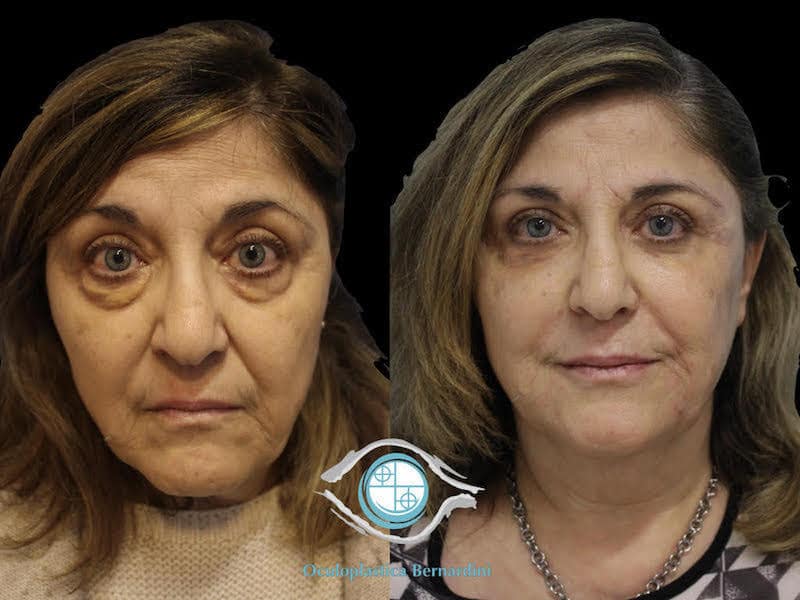
Among the most frequent abnormalities, lower eyelid bags should be mentioned first. This term refers to the herniation of the lower fat pads (medically known as steatoblepharon), which alters the normally hollow and concave contour of the eyelid.
The age at which lower eyelid bags form can vary greatly depending on constitutional factors and lifestyle habits, but they generally begin to appear around the age of thirty and become more noticeable over time.
An oculoplastic consultation aims to evaluate the position and strength of the lower eyelid in relation to the eyeball, the presence and extent of fat bags, any excess skin, a visible fold in the tear trough, and/or the presence of malar bags (excess skin folds on the cheekbone, lower than the fat bags).
All these conditions can combine in various ways and make the overall aesthetic imperfection of the lower eyelids more complex.
Lower blepharoplasty is currently too generic a term for the aesthetic surgery of the lower eyelids and has undergone numerous modifications over the past five years.
Lower Blepharoplasty: Recommended Techniques
The technique I most frequently recommend when dealing with isolated fat herniation (bags) is the removal of the fat pads via a transconjunctival approach.
Transconjunctival blepharoplasty allows access to the fat to be removed from the hidden part of the eyelid, the side in contact with the eyeball, without creating visible skin scars and excluding the risk of complications such as ectropion (lower eyelid retraction) secondary to skin removal.
In some specific cases, the fat from the eyelid bags is not completely removed but repositioned downward to fill the tear trough, especially if it is too visible.
Where there is also a mild excess of skin along with the fat, I tend to perform a hidden incision beneath the eyelashes, dissect the entire eyelid to the cheekbone, fix it to the periosteum of the upper orbital rim, and safely remove the excess skin using the SOOF lifting technique or malar lifting.
In all cases, the aesthetic result of lower blepharoplasty is consistently very good and natural, with limited risks and results lasting up to 10 years.
The unique experience in reconstructive eyelid surgery held by the oculoplastic surgeon makes complex upper eyelid surgery much safer and more reliable, while also allowing for a more personalized approach tailored to the specific aesthetic defect.
Discussing Lower Blepharoplasty
Lower blepharoplasty is one of the most successful procedures we’ve been performing for many years. The goal of lower blepharoplasty is to remove excess tissue, especially the bags under the lower eyelids, that puffiness caused by the fat that forms them.
This fat is normally present around the eyes, and we can say that the eyes are immersed in a cushion of fat that protects them from the surrounding bones. Over time, with the effects of gravity, this fat is pushed forward, pressing on the eyelid. So, this fat is partly excess fat and partly normal fat that is pushed forward.
It is also referred to as fatty hernias or adipose hernias, so the goal of blepharoplasty is twofold, depending on the patient: to remove the fat or reposition the fat.
Take the example of a young patient, 30 years old, with perfect skin on the lower eyelids but slightly pronounced bags.
This effect begins to be visible after the first 20-25 years, but it generally becomes evident around the age of 30.
Perfect skin, with a bit of puffiness, can be addressed using a minimally invasive approach, i.e., accessing the fat from behind the lower eyelid, in the area between the eyelid and the eye itself, without external scars and without leaving marks on the skin.
Through that incision, we access the fat, which is completely removed. The recovery is very quick, there are no external marks, and this approach eliminates the risk of complications, the worst of which for lower eyelids is the downward pull of the eyelid due to scars or excessive removal of the lower eyelid skin.
By going from the inside, this does not occur, so it results in a quick, safe, effective procedure with no scarring. Removing the fat does not alter the look or expression of the eye, it only rejuvenates it. Another case involves fatty bags in older patients, where the descent of the cheek and hollowing of the tear trough leads to dark circles.
The combination of bags, dark circles, and slightly relaxed eyelids is better addressed with another technique, the malar lift, which involves lifting the eyelid and the upper cheek through an incision just beneath the eyelashes, where women usually apply makeup, making it invisible. A flap of skin is lifted and repositioned, fixed to the bone, stretching and repositioning the skin, so that the wrinkles benefit from the treatment, and the excess fat forming the bags is reused and repositioned to fill the empty area.
This combination of filling the hollows, i.e., bags and dark circles, and stretching the skin upwards creates a very natural and rejuvenating effect. Fixing the skin to the bone supports the eyelid and reduces the risk of it being pulled downward.
Thus, this is the philosophy of personalized rejuvenation, tailored to age groups. We can personalize, optimize, and perform the right procedure for that particular patient, i.e., the customization of the surgical approach from patient to patient.
